How Rare Is a Stellium? A Statistical and Astrological Analysis
Explore the statistical probability and astrological significance of stellium formations. Discover what makes certain planetary clusters exceptionally rare.
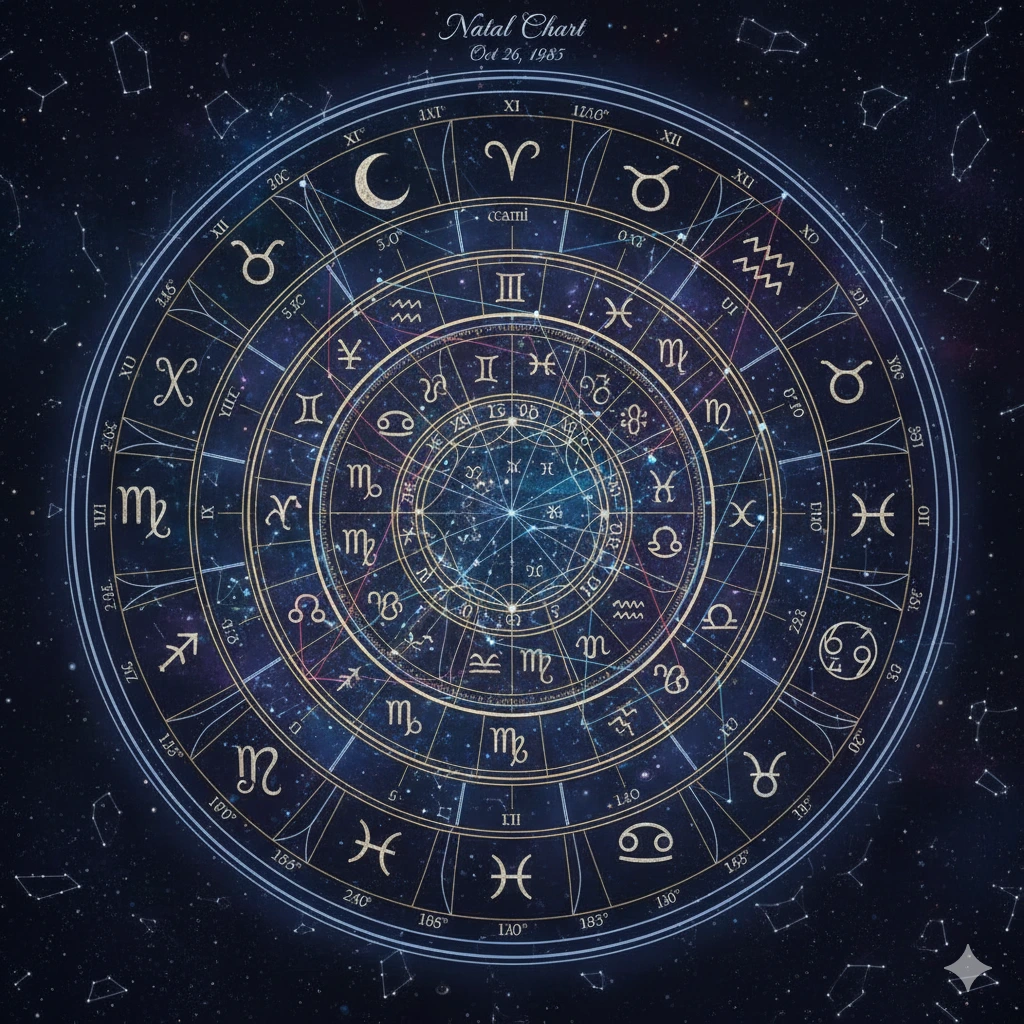
Explore the statistical probability and astrological significance of stellium formations. Discover what makes certain planetary clusters exceptionally rare.
Statistical Perspective: The rarity of a stellium in astrology is a nuanced question that depends heavily on the definition used, the planets included, and the mathematical parameters applied. While stelliums are not everyday occurrences, they are far from being once-in-a-generation anomalies. Their perceived rarity stems from their profound impact when they do occur, making them stand out in chart interpretation.
A precise assessment requires breaking down the variables that determine what constitutes a stellium and how frequently such configurations occur in both the sky and individual birth charts.
The frequency of stelliums hinges entirely on the astrologer's criteria. The core variables are:
For a basic statistical model using the seven classical planets and defining a stellium as any three or more in the same 30-degree zodiac sign, the probability is moderate. The planets are not evenly distributed; they cluster due to the geometry of the solar system (all planets orbit roughly in the same plane, the ecliptic). Mercury and Venus, as inner planets, are always found near the Sun, creating a frequent core for potential stelliums involving the Sun.
A stellium of three planets (from the seven classical) in one sign is not exceptionally rare. Over the course of a decade, you will find many such configurations. For example, in 2020, there was a notable stellium in Capricorn involving Jupiter, Saturn, and Pluto, with Mercury and the Sun periodically joining.
Rarity Escalation: When you increase the parameters, the rarity escalates sharply:
This is a crucial distinction in understanding stellium rarity:
| Aspect | Personal Chart Stellium | Generational Stellium |
|---|---|---|
| Planets Involved | Personal planets (Sun, Moon, Mercury, Venus, Mars) | Outer planets (Jupiter, Saturn, Uranus, Neptune, Pluto) |
| Timeframe | Specific birth moment (exact time sensitive) | Months to years (affects entire generation) |
| Rarity Level | More unique to individual | Common for the generation |
| Moon Inclusion | Requires specific birth timing (increases rarity) | Not typically included |
| Astrological Impact | Personal destiny and character focus | Collective themes and generational characteristics |
* Generational Stelliums: These involve slow-moving outer planets (Jupiter, Saturn, Uranus, Neptune, Pluto) and occur for everyone born during that period. For instance, the Pluto-Uranus conjunction in Virgo in the mid-1960s formed a generational stellium for those born then, especially when joined by Mars, Venus, or Mercury. These are not rare for the generation but define its collective character.
* Personal Chart Stelliums: These are unique to an individual's birth moment and involve the personal planets (Sun, Moon, Mercury, Venus, Mars) clustering in a sign or house. The inclusion of the Moon is particularly significant, as it moves about 12-13 degrees per day. For a stellium to include the Moon, the individual must be born within a specific, often narrow, window of time when the Moon transits through the sign containing other planets. This makes personal stelliums involving the Moon more unique and "rarer" on an individual level.
Key Insight: For a stellium to include the Moon, the individual must be born within a specific, often narrow, window of time when the Moon transits through the sign containing other planets. This makes personal stelliums involving the Moon more unique and "rarer" on an individual level.
The rarity of a house stellium (three or more planets in one astrological house) is entirely dependent on the accuracy and specificity of the birth time. Because the house cusps move approximately one degree every four minutes, a stellium that appears in the 9th house for a birth at 8:00 AM could straddle the 8th and 9th houses for a birth at 8:15 AM. Therefore, a precise, tight house stellium is uniquely personal and can be considered "rare" for that individual, as it requires a specific planetary alignment at a specific moment and location.
"The 'rarity' of a stellium is less about sheer statistical improbability and more about astrological significance. When a stellium occurs, it creates a dominant, unmistakable focal point in the chart that can overshadow other placements."
So, how rare is a stellium? Here's a contextual breakdown:
| Rarity Level | Configuration | Frequency |
|---|---|---|
| Common | Loose grouping of 3 planets (including outer planets) in one sign over 30° | Several times per year |
| Uncommon | 4 planets in one sign, or tight personal stellium of 3 including Moon | Several times per decade |
| Rare | 5+ classical planets in one sign with moderate orb | A few times per century |
| Very Rare | 5+ personal planets in tight orb (within 10 degrees) | Exceptionally uncommon |
| Uniquely Personal | Precise house stellium dependent on exact birth time | Unique to individual |
Ultimately, the "rarity" of a stellium is less about sheer statistical improbability and more about astrological significance. When a stellium occurs, it creates a dominant, unmistakable focal point in the chart that can overshadow other placements. This psychological and interpretive weight makes it feel special and noteworthy, regardless of the exact frequency of its occurrence. For those wishing to investigate the occurrence of historical stelliums, resources like Astro.com's ephemeris tools or Wikipedia's lists of planetary conjunctions can provide concrete data.
For a limited time, you can receive a free copy of 'The Astrologer's Guide: Mastering Birth Chart Interpretation' by subscribing to our newsletter. Get your free book here: https://hermesastrology.substack.com/p/your-free-book
The rarest type of stellium is a tightly concentrated stellium involving five or more of the personal planets (Sun, Moon, Mercury, Venus, Mars) in a single sign, with a very close orb (e.g., within 5-7 degrees). This requires a precise astronomical alignment where the fast-moving Moon and Mercury-Venus duo (which are always near the Sun) all converge with Mars in a narrow sector of the zodiac at the moment of birth. An example would be having the Sun at 15° Leo, the Moon at 18° Leo, Mercury at 16° Leo, Venus at 12° Leo, and Mars at 19° Leo. Such a configuration focuses an immense amount of core life energy into one archetype, making it exceptionally potent and uncommon on an individual level.
Having two distinct stelliums in a natal chart is less common than having one, but it is not extraordinarily rare. It indicates a chart where planetary energy is concentrated in two primary areas (signs or houses), creating a life narrative with two powerful, often competing or complementary, centers of gravity. Its frequency depends on the strictness of definition. If using a loose orb and three planets per stellium, it can occur periodically. If requiring four planets per stellium or very tight orbs, the occurrence becomes less frequent. The uniqueness lies in the specific combination and the dynamic aspect pattern between the two stelliums, which creates a highly specialized life focus.
Major grand stelliums involving five or more planets in one sign are noteworthy astronomical and astrological events that typically happen a few times per century. These are often generational markers. The 1962 Aquarius alignment (7 planets) is a famous 20th-century example. A more recent significant clustering occurred in late 2020, with Jupiter, Saturn, Mercury, and the Sun in Capricorn, closely followed by Venus and Pluto. These events are cyclical and predictable through astronomy. Their astrological significance is interpreted as defining the collective themes for those born under them and triggering major world events during their exact formations. You can review historical planetary alignments on NASA's ephemeris resources for precise data.
Including outer planets (Uranus, Neptune, Pluto) in a stellium does not make it "less special," but it changes its nature from personal to generational. A stellium containing an outer planet is shared by everyone born within a period of months or even years. For example, a stellium of Sun, Mercury, and Uranus in Taurus will affect an entire cohort. What makes it personally significant is how this generational energy integrates with your unique personal planets (Moon, Ascendant, etc.) and houses. The "special" quality comes from the individual chart context, not the outer planet's presence alone. The outer planet adds a layer of collective, transformative, or transcendental energy to the personal themes of the stellium.
Even if a particular planetary grouping is not astronomically rare (e.g., a Sun-Mercury-Venus conjunction, which occurs annually), its astrological meaning is never diluted or "too common" when it appears in an individual's birth chart. In natal astrology, the chart is a map of the soul at a unique moment in time and space. A stellium's meaning derives from its central role in that specific chart—its house placement, the aspects it makes to other personal points (like the Ascendant or Moon), and its condition. A "common" three-planet stellium occupying the 10th house and squaring the native's Saturn will have a profoundly impactful and unique manifestation in that person's life, regardless of how often that planetary trio conjoins in the sky. The meaning is personalized, not generalized.
While statistical analysis helps us understand the frequency of stellium formations, the true measure of a stellium's importance lies in its astrological impact rather than its mathematical rarity. A stellium's power comes from its ability to concentrate planetary energy into specific life areas, creating themes that dominate an individual's experience and development.
The most meaningful approach to stellium analysis recognizes that even "common" configurations become profoundly unique when personalized through house placement, aspects, and integration with the rest of the birth chart. Whether a stellium occurs once a year or once a century, its significance in an individual's life is determined by how that concentrated energy interacts with their unique astrological blueprint and life circumstances.
