Stellium in Vedic Astrology: The Concentration of Karmic Force
Discover how planetary clusters in Jyotisha reveal profound karmic patterns, life purpose, and spiritual destiny according to ancient Vedic wisdom.
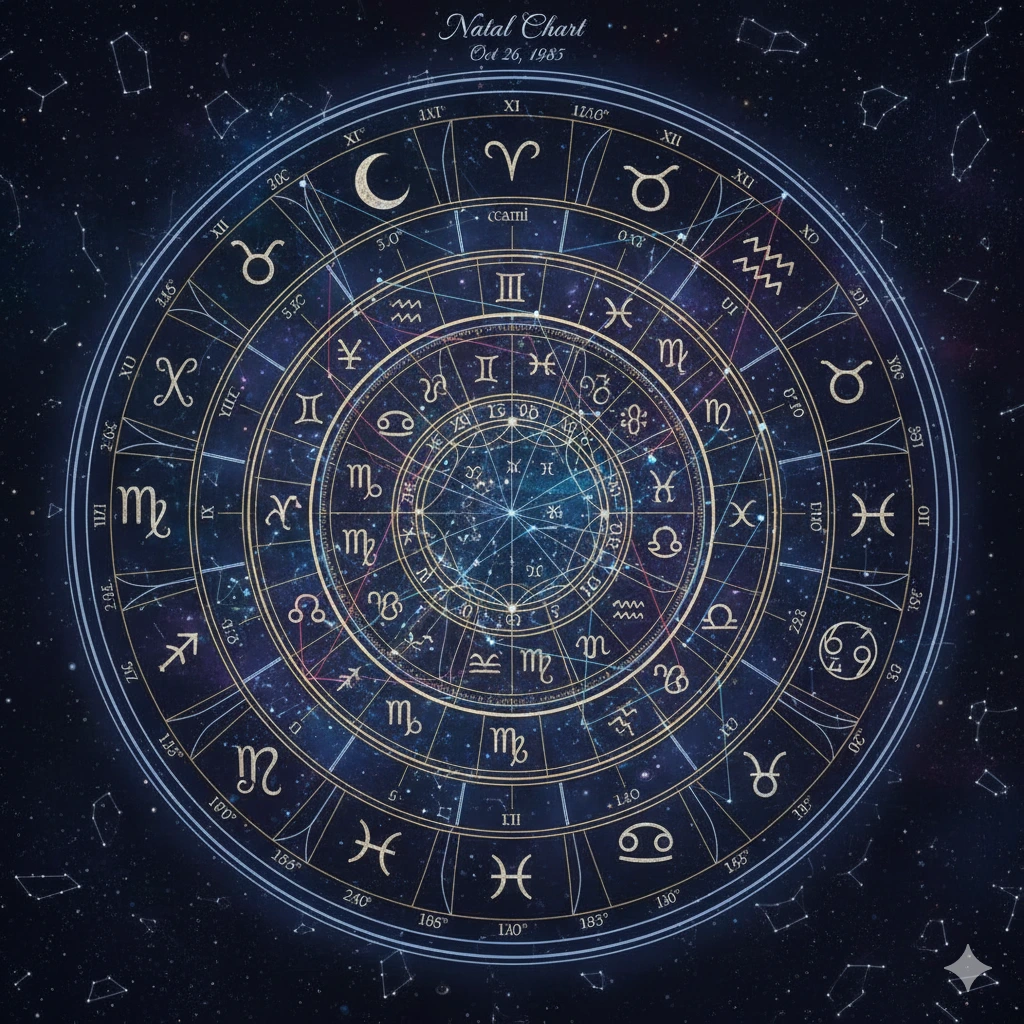
Discover how planetary clusters in Jyotisha reveal profound karmic patterns, life purpose, and spiritual destiny according to ancient Vedic wisdom.
Vedic Perspective: In Vedic astrology (Jyotisha), the concept of a planetary cluster holds profound significance, but its interpretation is distinctly rooted in the system's philosophical and karmic framework. A stellium, often referred to as a "Graha Samūha" (planetary conglomeration), is not merely a point of personality focus as often viewed in Western astrology, but a powerful karmic indicator that reveals where the soul has accumulated immense saṃskāras (impressions) and where the destiny is heavily weighted for this lifetime.
The analysis of such concentrations involves intricate layers of sign, house, divisional charts, and planetary war (Graha Yuddha), making it a subject of deep astrological scrutiny.
While Western astrology often uses a three-planet benchmark, Vedic astrology traditionally requires a tighter orb and considers four or more planets in a single sign or house to constitute a significant conglomeration. The luminaries (Sun/Sūrya and Moon/Chandra), the five classical planets (Mars/Maṅgala, Mercury/Budha, Jupiter/Guru, Venus/Śukra, Saturn/Śani), and the lunar nodes (Rāhu and Ketu) are all considered. However, there is debate about including Rāhu and Ketu, as they are shadow planets; many purists count only the seven physical bodies.
The standard definition in classical texts like Bṛhat Parāśara Horā Śāstra implies a close conjunction, typically within a few degrees. A cluster of planets in one rāśi (zodiac sign) or bhāva (house) concentrates their energies into a single area of life, creating a dominant theme that can override other chart influences. This is seen as a karmic focal point, where both the rewards (phala) and challenges (pariṣaha) of past actions are due for intensive experience and resolution.
The interpretation of a Vedic stellium hinges on two pivotal factors:
The planet that rules the sign containing the stellium becomes the key dispositor of all that concentrated energy. Its condition—its sign placement, house placement, aspects (dṛṣṭi), and strength (bala) in the Daśāṃśa (D-10 career chart) and other divisional charts—determines whether the stellium's effects will manifest positively or negatively. If the dispositor is strong and well-placed, it can brilliantly manage and express the energies of the cluster. If it is weak, afflicted, or in an unfavorable house (like the 6th, 8th, or 12th), the native may struggle to harness the stellium's power, leading to frustration, obstacles, or misdirected efforts.
The bhāva where the stellium sits becomes the primary stage for its drama. A stellium in a Kendras (1st, 4th, 7th, 10th—angular houses) gives immense drive and makes the matters of that house central to the native's life purpose and identity. A stellium in a Trikonas (1st, 5th, 9th—trine houses) brings fortune and spiritual support to that area. However, a stellium in a Dusthāna (6th, 8th, 12th—malefic houses) indicates that the soul must work through deep-seated karmic debts, hidden enemies, losses, or profound transformations in that sphere. The house reveals the field of life where the karmic account is being settled.
Karmic Insight: A stellium represents a karmic debt center where the soul has chosen to work through a massive bundle of past-life impressions in a specific domain. This creates an innate expertise and obsession with the matters of that sign and house, but also a potential blindness or compulsion.
A stellium often forms powerful Yogas (planetary combinations). Classical texts describe many Yogas based on planetary groupings in specific signs and houses. For instance, planets in their own or exaltation signs in a Kendra can create formidable Rāja Yogas (combinations for success and authority). However, the interplay within the stellium is critical.
The true strength and specific manifestation of a stellium are assessed not only in the birth chart (Rāśi Chakra or D-1) but also in the relevant divisional charts. The Daśāṃśa (D-10) is paramount for career implications. The Saptāṃśa (D-7) reveals its impact on progeny, and the Drekkāṇa (D-3) shows its role in siblings and courage. If the stellium holds strong in these divisional charts, its positive effects are confirmed and magnified. If it dissolves or is afflicted in the divisional charts, the promise of the main chart may not fully materialize in that specific area of life.
The Vedic Daśā (planetary period) system is where the stellium's karma unfolds in time. When the major period (Mahādaśā) or sub-period (Antardaśā) of the stellium's sign lord runs, the native enters a phase dominated by the themes of that stellium. This can be a time of great achievement if the yoga is strong, or intense challenge if afflicted. Similarly, the periods of the planets within the stellium will activate their specific energies within the larger context of the cluster. For example, during the Venus period within a Taurus stellium, the artistic, relational, and material comforts of that stellium come to the forefront. Calculating these precise periods requires specialized software, such as that provided by Astro-Seek's Vedic Astrology tools.
Consider a stellium of four planets in Capricorn (an earthy, disciplined sign ruled by Saturn) in the 10th house of career, karma, and public status. This immediately suggests a destiny (daiva) heavily focused on professional achievement and societal responsibility. The key dispositor is Saturn. If this Saturn is placed in a strong position like its own sign in the 11th house of gains and aspected by Jupiter, it indicates the native can brilliantly organize (Capricorn) and endure (Saturn) to achieve great career success (10th house), reaping financial rewards (11th house). This could form a powerful Rāja Yoga.
However, if that same Saturn is placed in the 8th house of obstacles and afflicted by Mars, the path to career success will be fraught with sudden setbacks, power struggles, and chronic anxiety. The stellium's energy is still potent, but its expression is hindered and transformed by the dispositor's weakness. The native may work in fields related to the 8th house—surgery, insurance, inheritance, or occult sciences—to manage that intense energy.
"In Vedic astrology, a stellium is not a personal quirk but a karmic assignment. Understanding its lordship and placement allows one to move from being a passive subject of its intensity to an active manager of a significant portion of their soul's evolutionary portfolio."
From a Vedic perspective, a stellium represents a karmic debt center. The soul has chosen to work through a massive bundle of past-life impressions in a specific domain. This creates an innate expertise and obsession with the matters of that sign and house, but also a potential blindness or compulsion. The spiritual path involves using the discipline of Jyotisha to become consciously aware of this concentration, to strengthen the dispositor through remedial measures (upāyas) like gemstones, mantras, or charitable acts, and to consciously direct this concentrated energy toward dharma (right action) rather than allowing it to manifest as uncontrolled destiny (prārabdha karma).
The ultimate goal is to recognize the stellium not as a personal quirk but as a karmic assignment. By understanding its lordship, house placement, and strength in divisional charts, the individual can move from being a passive subject of its intensity to an active, skillful manager of a significant portion of their soul's evolutionary portfolio.
For a limited time, you can receive a free copy of 'The Astrologer's Guide: Mastering Birth Chart Interpretation' by subscribing to our newsletter. Get your free book here: https://hermesastrology.substack.com/p/your-free-book
In Vedic astrology, the standard for a significant planetary conglomeration or stellium is typically four or more planets occupying a single sign (rāśi) or house (bhāva). While three planets in conjunction are noted and analyzed, the classical emphasis is on larger clusters that create a dominant karmic force. The planets counted usually include the seven classical bodies—Sun (Sūrya), Moon (Chandra), Mars (Maṅgala), Mercury (Budha), Jupiter (Guru), Venus (Śukra), and Saturn (Śani). The inclusion of the lunar nodes Rāhu and Ketu is more nuanced and depends on the specific tradition of the astrologer. The defining characteristic is the close proximity of the planets, often within a 5-10 degree range.
The most powerful and impactful houses for a stellium are the Kendra houses—the 1st (self), 4th (home/happiness), 7th (partnerships), and 10th (career/karma). These angular houses represent pillars of life, and a stellium there concentrates immense energy into foundational areas, making those themes dominant and often publicly significant. Among these, the 10th house stellium is considered particularly potent for shaping one's destiny, career, and public role, as it is the house of action and dharma. However, a stellium in a Trikona house (1st, 5th, 9th) can bring great fortune (lakshmi) and spiritual support to that area, as these are houses of luck and higher wisdom.
In Vedic astrology, the dispositor lord—the planet that rules the sign where the stellium is placed—is the single most important factor in determining the results of the stellium. This lord acts as the manager or CEO of all the concentrated planetary energy. If the dispositor is strong (uchcha in exaltation, swasthana in its own sign), well-placed in a favorable house (like a Kendra or Trikona), and receiving good aspects, it can channel the stellium's power toward highly positive and successful manifestations, often creating a powerful Rāja Yoga. If the dispositor is weak (nīca in debilitation), combust, or placed in a malefic house (6th, 8th, 12th), it becomes unable to properly manage the energy, leading to frustration, obstacles, and unfulfilled potential despite the native's intense focus in that area.
A stellium is not inherently good or bad; it is a concentration of karma. However, it can certainly manifest as a major challenge if the stellium is afflicted. This occurs if: 1) The stellium is placed in a malefic Dusthāna house (6th, 8th, or 12th), indicating areas of debt, struggle, or loss. 2) The dispositor lord is weak or afflicted. 3) The stellium consists primarily of natural malefics (Saturn, Mars, Sun, Rāhu) without benefic influence. 4) It forms a Pāpa Kartari Yoga (surrounded by malefics). In such cases, the native may experience intense pressure, obsession, setbacks, or compulsion related to the stellium's house and sign themes, requiring great effort and spiritual discipline to overcome.
In Vedic terminology, all planets in a stellium are in conjunction with each other, but a conjunction (yuti) typically refers to the pairing or grouping of two or three planets. A stellium (graha samūha) specifically denotes a larger, more impactful cluster of four or more planets. The distinction is one of degree and emphasis. A conjunction of two planets modifies their mutual energies; a stellium creates a new, dominant "planetary government" in that part of the chart that can overshadow other influences. Furthermore, Vedic analysis of any conjunction, including within a stellium, meticulously applies rules of Graha Yuddha (planetary war) when planets are extremely close, which can designate a victor and a defeated planet, adding another layer of interpretation not commonly used in Western astrology. For foundational astronomical concepts underpinning these positions, Britannica's entry on the Zodiac is a useful reference.
In Vedic astrology, a stellium is far more than a planetary pattern—it is a karmic compass pointing to where the soul's evolutionary work is most concentrated in this lifetime. Through the intricate analysis of sign lordship, house placement, divisional chart strength, and the timing of Dasha periods, the Jyotishi can discern not just personality traits, but the very structure of one's karmic assignment.
The ultimate wisdom in understanding a Vedic stellium lies in recognizing it as an opportunity for conscious evolution. By strengthening the dispositor lord through appropriate remedies and consciously directing the stellium's immense energy toward dharma, the individual transforms what could be a fateful compulsion into a purposeful mastery. In this light, the stellium becomes not a prison of karma, but a workshop for the soul's deliberate refinement and a powerful engine for fulfilling one's unique dharmic purpose.
